Staying fit has many benefits. You are strong and flexible, active and energetic, and you have a healthy heart and are at the right weight. Regular exercise not only prevents diseases such as diabetes, heart disease, and certain types of cancer, it also combats depression, anxiety, and stress to promote better mental health.
Finally, fitness optimizes your lifestyle to promote healthy aging and support longevity, by encouraging you to prioritize consistent physical activity and better lifestyle choices. Fitness gadgets enhance healthy habits by providing key metrics and insights.
Fitness technology improves health and fitness by providing personalized data, motivation, and insights to support a healthier lifestyle. These devices measure your heart rate, steps taken, and rest patterns. This information helps you to work out at your target heart rate zone, to stay active by getting your steps in, and to obtain quality rest.
Fitness technology also helps you to stay motivated. When you set goals for calories burned, minutes worked out, and steps walked, you can be proud of yourself when you meet them. In addition, the social features let you share your progress with friends, establishing motivation and accountability.
Finally, by tracking your progress over time, fitness wearables keep you engaged and working hard by showing insights on how much you have improved. In the following sections, I will introduce some fitness gadgets that provide these crucial insights.
Heart rate monitors
A heart rate monitor detects and checks your pulse rate continuously. Heart rate is how many times your heart beats per minute, while pulse rate is how many times your arteries expand due to your heart beating.
Heart rate monitors work in two ways. The first way is through using electrocardiography. Your heart generates a small electrical current with every heartbeat, and heart rate monitors with electrical detection capabilities can track this current. The second way is optical, through photoplethysmography. These devices use infrared light to see the expansion of your arteries as your heart pumps blood through them, tracking your pulse rate. Some heart rate monitors also estimate the oxygen levels in your blood.
Types of heart rate monitors
Chest-Band Devices
Chest-band devices are the most accurate. By using a band that wraps around your chest, these devices get your heart rate by monitoring the electrical current of your heart. However, in order for these devices to work as designed, they must be wet, or you need to use a conductive gel where the sensors touch your skin. Both water and conductive gel improve conduction, making it easier for the device to detect your heart’s electrical current.
Wrist or Forearm-Located Wearables
Wrist or forearm-located wearables use light-emitting diodes (LEDs) and sensors that rest against the skin in the area at the surface of your wrist and forearm, where two major arteries are located. The LED sensors can detect the tiny expansions of the blood vessels beneath the skin’s surface. Although the detection can be very accurate when resting, walking, or running, the reading could become inaccurate if your arm moves as part of the exercise.
Smart Rings
Smart rings are relatively new on the market, and you wear them on your finger like a piece of jewelry. Smart rings monitor heart rate and other vital signs using optical detection. These devices give accurate measurement of heart rate when resting. However, more research is required concerning its accuracy during exercise or other activities.
Smartphone Apps
Smartphone apps detect your pulse rate in mainly two ways. First, by holding your finger to the camera lens, the flash is able to use optical detection to find your pulse rate, with the camera’s flash used to illuminate the blood vessels under your skin. Others use the camera held directly in front of your face, tracking visible, but undetectable to the human eye, changes in your skin to measure your pulse rate. Though smartphone apps that require you to touch the lens are more accurate than those that use the camera to scan your face, their measurements are prone to errors because smartphones are not intended to handle this use case.
Risks of Using Heart Rate Monitors
The risks for using heart rate monitors are minimal, besides possible allergy to the material that makes up the device or band. However, these devices are no substitutes for medical devices for monitoring health conditions. You must use devices approved by the U.S. Food & Drug Administration (or from the appropriate regulatory agency in your country), because medical devices should meet strict quality and accuracy standards.
Pedometers
Pedometers are step counters that can be hooked onto your pants, waistband, or shoes when walking or running. Some benefits of getting your steps in include decreased risk of and management of chronic diseases like diabetes and heart disease, improvements in bone density, decreases in blood pressure, reduction in certain types of cancer, increases in muscle strength and endurance, alleviation of symptoms of depression, and elevation of mood.
Research shows that pedometers tend to count steps more accurately at speeds greater than 3 miles per hour (mph) than at slower speeds. Accuracy can exceed 96% when speeds exceed 3 mph, whereas the accuracy drops to between 74%-91% at speeds from 2 mph to 3 mph, and it drops even further to between 60%-71% at speeds below 2 mph. Pedometers are more prone to error at slower speeds due to it being less sensitive to steps when people shuffle or drag their feet. They work well when they are able to detect vertical movement of the hips.
Step count is also influenced by stride length and speed of walking. For example, pedometers underestimate distance for fast walkers and overestimate it for slower ones, unless the slow walker compensates by taking longer strides. Due to the nature of the pedometer to overcount or undercount, it is a good idea to test the accuracy of your specific device. Take 100 steps and check with the pedometer. If you get a range between 95 and 105, then your pedometer is accurate enough to use.
Types of pedometers
Spring-Levered
These devices use a spring-suspended horizontal lever arm that moves up and down in response to the vertical acceleration movement of your hips as you walk or run. The movement opens and closes an electrical circuit. When the lever arm makes contact, a step is registered. Spring-levered pedometers must be placed in a vertical plane for them to work. If they tip over to a horizontal plane, they will not work.
Piezoelectric
Piezoelectric is a material that generates an electric charge when it is mechanically deformed. Piezoelectric pedometers use a horizontal cantilevered beam with a weight on the end that compresses a piezoelectric crystal, when subjected to movement like walking or running. This generates a voltage proportional to the acceleration, and the voltage oscillations are used to record steps.
Accelerometers
Accelerometers detect acceleration, or the rate of change in velocity over a given time, of body movements with the sensors. Accelerometers are able to assess the frequency, intensity, and duration of physical activity as a function of body movement with the sensors. Accelerometers consist of piezoelectric transmitters that are stressed by acceleration forces. This stress produces an electrical signal, which is converted by processing units to produce an indication of movement. Major advantages of accelerometers include their small size and their capacity to record data continuously over days and weeks. Many research studies have found them to be objective, practical, noninvasive, accurate, and reliable tools to quantify physical activity volume and intensity, with minimal discomfort.
Types of accelerometers
Varieties of accelerometers include the simple uniaxial type, which measures acceleration in one axial plane of motion, and the triaxial type, with three planes of motion. The triaxial type is far more precise.
Electronic activity monitors
Electronic activity monitors are sophisticated fitness trackers that can be worn on the wrist, clipped to clothing, or incorporated into smartphones. Most use an accelerometer to monitor movement, even during sleep, and some versions add GPS technology. Optical sensors for heart rate are common and provide useful data to optimize exercise intensity. Virtually all monitors sync with smartphones or personal computers for tracking and graphic display of physical activity, calorie expenditure, and more. The next section will highlight three of these electronic fitness trackers.
Types of Electronic Fitness Trackers
The Oura Ring
The Oura ring is a sleep and fitness tracker, monitoring your sleep, activity, stress, heart rate and more. Using the pulse rate through your finger, the Oura ring provides personalized health insights, using research grade sensors to monitor over 20 biometrics with precision. In addition, the Oura ring is compatible with iOS and Android, and it integrates with over 40 apps including Apple Health, Google Health Connect, Natural Cycles, Flo, Strava, & more.
The Fitbit
The Fitbit app and smartwatches make it easy to track health metrics like oxygen levels, saturation or oxygen levels in your blood (SpO2), skin temperature, breathing rate, heart rate variability, and resting heart rate to uncover trends and changes to your well-being. With these metrics, Fitbit is able to optimize your routine with a score that gives personalized workout intensity and recovery recommendations based on your body.
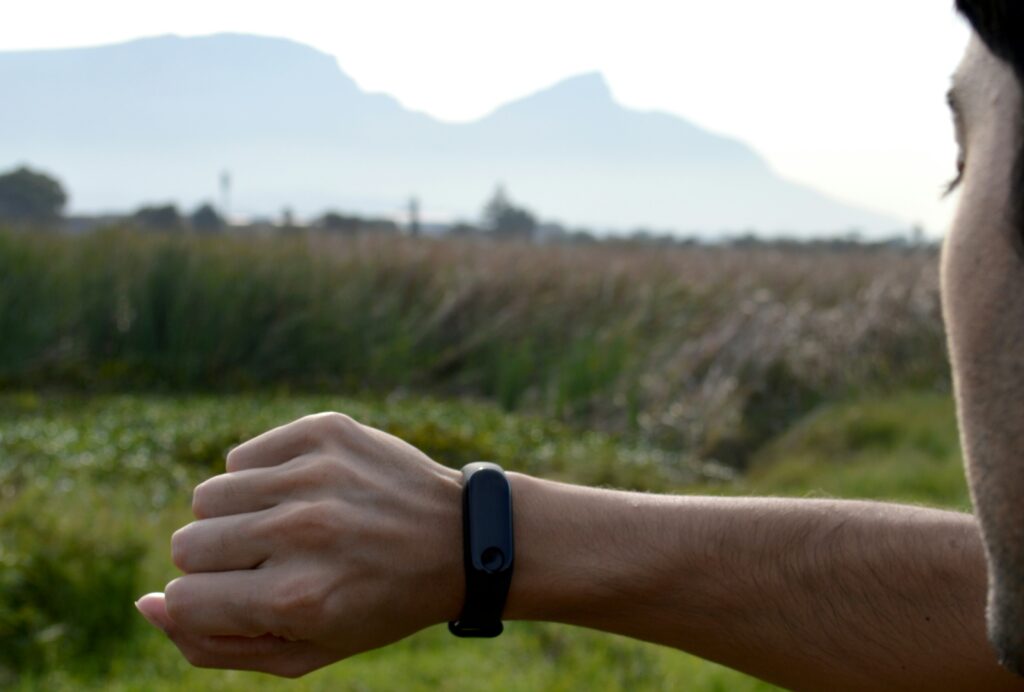
You can use the Fitbit to understand how your body handles stress, gain awareness of your emotional well-being, and learn strategies to better manage your stress. Fitbit’s advanced sleep tools can also help you get better rest, increase your energy, and improve your well-being.
WHOOP 4.0
Whoop 4.0 is a wearable fitness device that provides continuous monitoring of physiological data, including heart rate, respiratory rate, resting heart rate, heart rate variability, skin temperature, blood oxygen levels, daily activity, and sleep. This information gives you a better understanding of your overall health and wellness and track your progress over time. In addition, WHOOP uses insights from the above health data to provide you with clear next steps, allowing you to understand and improve your overall health and optimize performance. With the WHOOP Journal, you can log your daily behaviors such as activity, diet, alcohol consumption, stress levels, and caffeine intake. WHOOP then calculates which behaviors help or hurt your sleep and recovery most, making it easier to stick with healthy habits. Finally, WHOOP offers a supportive community of users, including professional athletes and fitness enthusiasts, sharing experiences and insights to inspire you to reach your goals.
Conclusion
Fitness gadgets help you maintain a healthy lifestyle by providing you with useful insights. Whether it is tracking your heart rate, step count, or daily behaviors, fitness technology use these data to help you make healthy choices. Each healthy choice, then, is a step toward reaping the benefits of a fit life.
Comments are closed